
In 2017, a state agency brought my team in to develop an improvement strategy for hundreds of schools in the bottom 5% of performance.
We knew principals were one of the most important levers for improving schools, and the state was considering investing more in principal training and support. We wanted to know: were principals getting the support they needed?
We surveyed and spoke with principals and school districts, regional service centers, and third-party organizations supporting them.
One principal had nine “coaches” between all of these agencies and entities. Nine. Seriously.
Nine different individuals asking probing questions, sharing advice, and sometimes telling this principal what to do. That meant at least nine meetings a month, and some of them met weekly. None of these coaches, even the ones deployed by the same district, were coordinating on priorities between conversations.
Another principal estimated she was spending 30 hours per month preparing for, sitting in, and following up on her “support.”
I was trying to express the madness we were seeing, so I walked up to a whiteboard and started drawing.
It looked something like this:
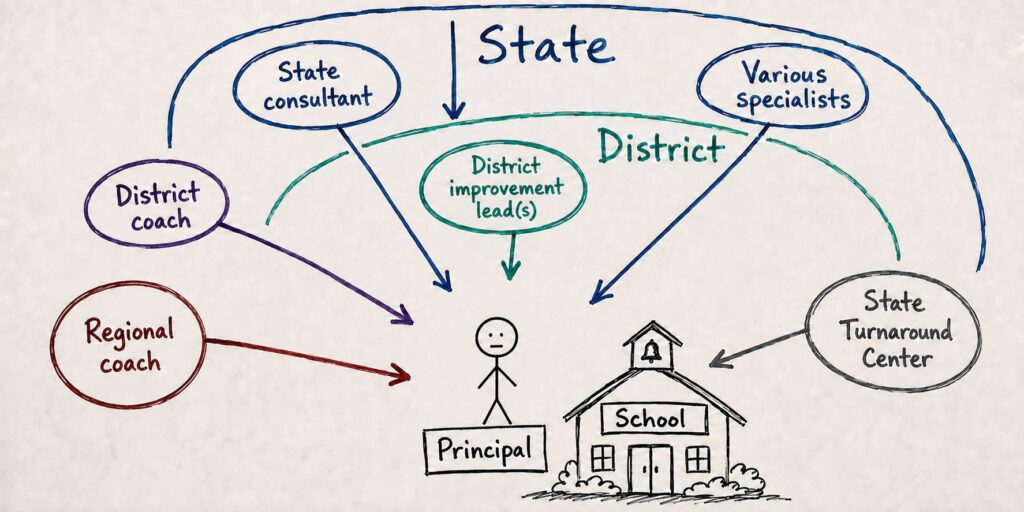
That crude drawing became something I now call a support map. It didn’t take long for the state to reallocate millions of dollars that had been going to uncoordinated and overwhelming “support.”
Over the following year, principal satisfaction improved, and fewer principals were reporting conflicting priorities as a major barrier to improvement.
This is the most extreme case I’ve seen, but I’ve been using support maps ever since. They take about five minutes to sketch out.
Grab a sheet of paper or step up to a whiteboard. In the middle, write the stakeholder group or individual you are most dedicated to supporting right now. We’ll call this your target.
Some example targets:
- Struggling readers
- New school principals
- Teachers implementing a new curriculum
- Grantees
Next, write every form of support you’re aware that your target is getting, whether you’re providing it or it’s coming from another source. Anywhere on the page.
You’re almost done.
Look at the supports and consider:
- What do you notice?
- Is the support enough?
- Is it too much for your target to absorb and/or act on?
- Is it coordinated?
- Do you think it will work?
If it’s too much or uncoordinated, start with the one thing you most want your target to have or do. Cut and coordinate from there.
I’m struck by how often simply making the system visible helps leaders quickly improve support.


 ES
ES  EN
EN