
I developed a framework for educational program and school design that I’ve been using for about 12 years, with increasing conviction. Its roots are in human-centered design. In the last couple of weeks, I’ve used it in two very different settings: a university and leadership accelerator school for girls in rural Guatemala, and a basketball academy in the heart of Baltimore.
It’s still amazing to me (and I’m so grateful) that great leaders fly me around the world to help them engage with this framework, and that I can find it working in a community close to home that I care so much about. I want to share it with you today.
But first, I want to be upfront about something: this email is going to be more heady than usual. I aim for 2 minute emails. This one clocks in around 3.5 minutes. But if you stick with me here, I think there’s a good chance you’ll find it worth your time. (Plus, you may prove to yourself that your attention span hasn’t been completely destroyed by AI.)
The framework is very simple, perhaps deceptively so:
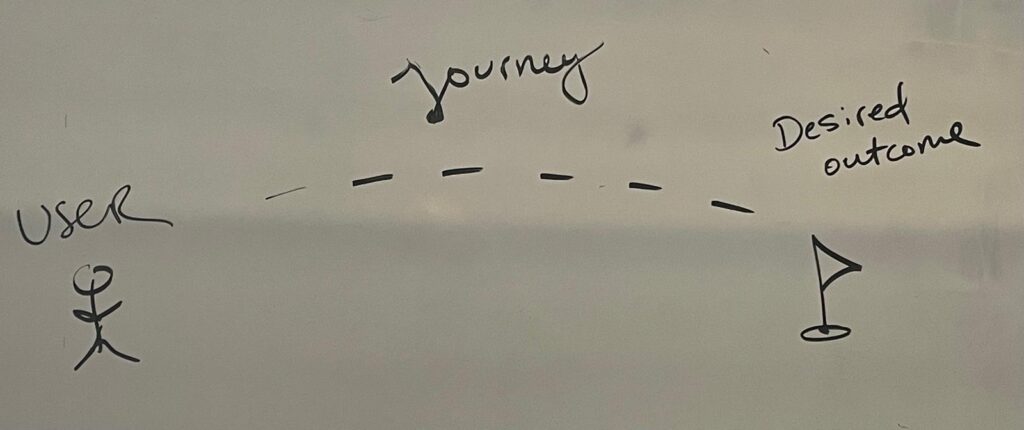
I draw it on whiteboards all the time: a user on a journey to a desired outcome.
That’s how I think about designing an educational program. It could be a school, a major at a university, a workforce program, or a classroom. And the “user” might be a student, an athlete, a participant, or an adult learner.
We start with the user and the desired outcome.
Who are we designing for? And what outcome are they giving us their time, and perhaps their money, to work toward?
Lots of schools and programs are fuzzy on one or both of those questions. Sometimes the user is poorly defined. Sometimes the outcome is. Sometimes they don’t match well, which can contribute to recruitment and dropout issues.
Once we’re clear on both user and outcome, we can ask: What journey does this person need to go on to develop what they’ll need to reach that outcome?
We start by identifying the competencies they need to get good at.
We humans learn to do things by doing them (hat tip to Aristotle). So the job of the designer is to connect “users” to experiences that give them repeated chances to practice, get feedback, and improve.
Imagine a university prep school serving aspiring first-generation college students growing up without much money. If we ask about the desired outcome, we might first hear “university.”
If we push a little harder, we might get to: “graduate from university within six years of finishing high school.”
Now we can ask what a first-generation college student without much money needs to be able to do to graduate from university within six years. Strong academics will surely matter. But so might interviewing effectively for scholarships, navigating student loan options, managing time, asking for help, and being in environments that feel unfamiliar.
One useful way to get at this is to look at why students like yours struggle. That gives us a kind of photographic negative of what they may need to learn.
Then we ask: What experiences would give students a safe place to practice those things, get feedback, and try again? Those experiences become the journey.
I always enjoy this part. When you start with a specific user and a specific outcome, you often end up surfacing competencies that wouldn’t have shown up if you had started by designing courses. In a recent conversation, a partner made the point that future leaders will need to know how to build and maintain a personal brand online. Conversations like these can move pretty quickly beyond traditional academics and toward what else young people will need to be able to do in the lives they are preparing to lead.
This framework changes what my partners build. And it leads to results. If money management is a critical competency, students need chances to practice managing money. If building a personal brand matters, they need chances to do that. Same for public speaking, time management, or anything else that emerges. The curriculum, schedule, staffing, partnerships, trips, coaching, internships, competitions, and everything else available to you become raw material for creating those chances. That’s the journey to design.
So there it is: a user on a journey to a desired outcome.
I hope it’s useful and that you enjoy the conversations that come out of it as much as I do.


 ES
ES  EN
EN