
In recent newsletters, I’ve shared a framework I use for educational program design: a user on a journey to a desired outcome:
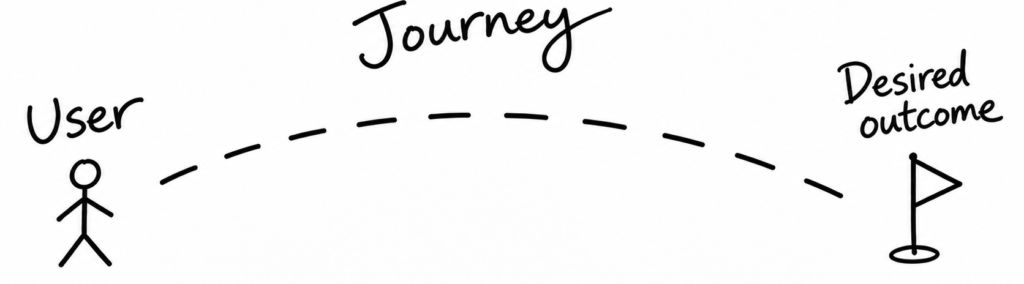
But what happens when the journey you’ve designed doesn’t quite get your users to the outcome you’re working toward?
Earlier this month, I gave a talk at the Central American Donors Forum, highlighting the work of several Guatemala-based organizations building bridges between education and economic opportunity.
Two of them, MAIA and Cooperative for Education (COED), are education organizations I’ve had the honor of partnering with over multiple years.
Both achieve secondary (high school) graduation rates several times higher than the comparative averages in the areas they serve. But when we listened to hundreds of students and families as part of their strategic planning processes, we heard a concern: What if I graduate and can’t find an opportunity to use what I’ve learned?
Students and recent graduates were identifying a gap between the end of the educational journey and the desired outcome. It’s a gap I see relatively often.
Imagine a program preparing aspiring first-generation university students. In the program the students develop their academic skills, study habits, and confidence. They graduate well prepared.
But what if they can’t afford the application fees? Or don’t have a laptop and internet connection with which to navigate the admissions process? Or don’t have access to scholarships?
Or imagine a workforce program whose graduates have the skills to succeed in a job, but lack the connections, transportation, or even the appropriate clothes to land one.
Sometimes, the remaining distance between your program and your desired outcome can’t be closed through teaching and learning alone.
Here’s how I think about it.
The educational journey is everything your users can be taught, practice, and learn. If they leave your program without the competencies they need, that’s a problem with the educational journey.
But sometimes students leave with the learning they need to be successful, and still can’t reach the desired outcome. The barriers are things like cost, access, transportation, or a lack of professional connections.
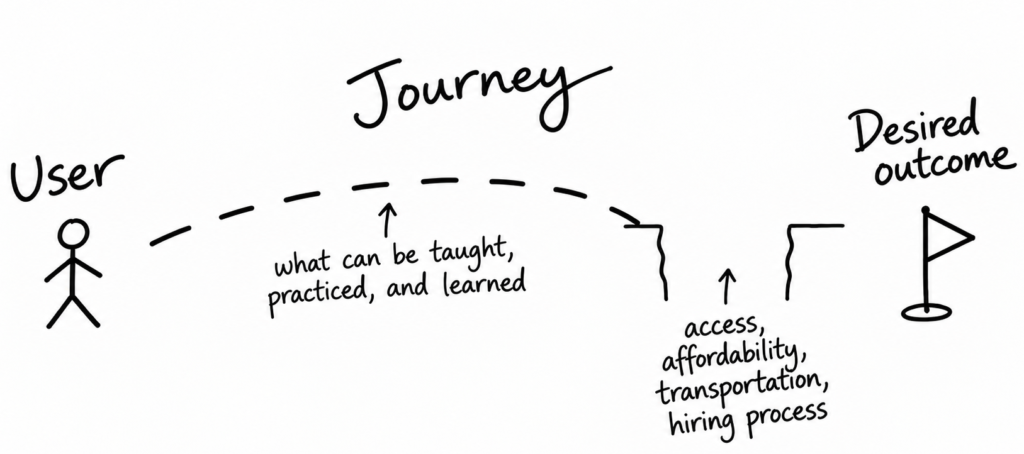
When you discover a gap like this, you have three options:
- Ignore it. (I wouldn’t recommend this one.)
- Narrow your stated outcome to reflect what your program can realistically accomplish.
- Build a bridge between the end of your program and the outcome you’re trying to achieve.
That third option doesn’t necessarily mean expanding your programming. Sometimes the smartest thing you can do is find a partner.
That’s what MAIA and COED are experimenting with. They’re building partnerships with employers and other organizations to help young people gain professional experience, develop connections, and access internships and employment opportunities.
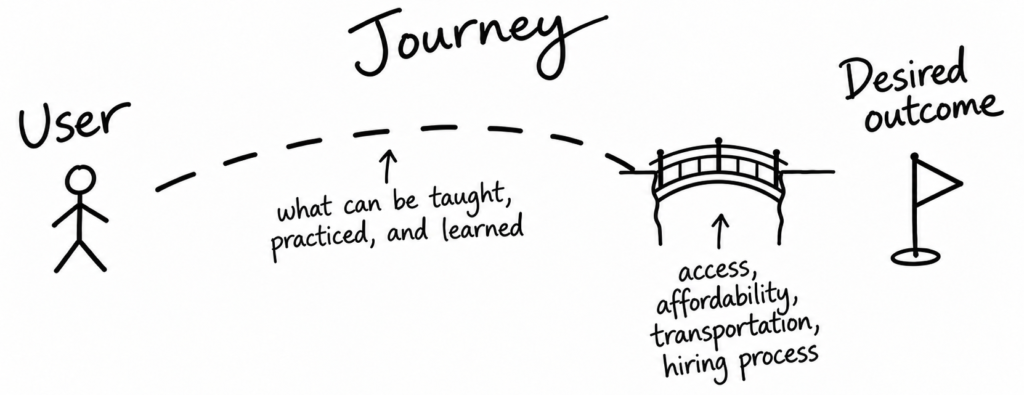
For your consideration: Where does your users’ journey end, and is there a gap between that point and the outcome you and they most want?
There might be a bridge worth building.
Rooting for you,
Rob


 EN
 ES